Trump says the U.S. leads China in AI. What do the numbers show?
Stanford’s figures put U.S. private AI investment at 23 times China’s in 2025. Its counts of notable models and its March performance snapshot tell different stories.
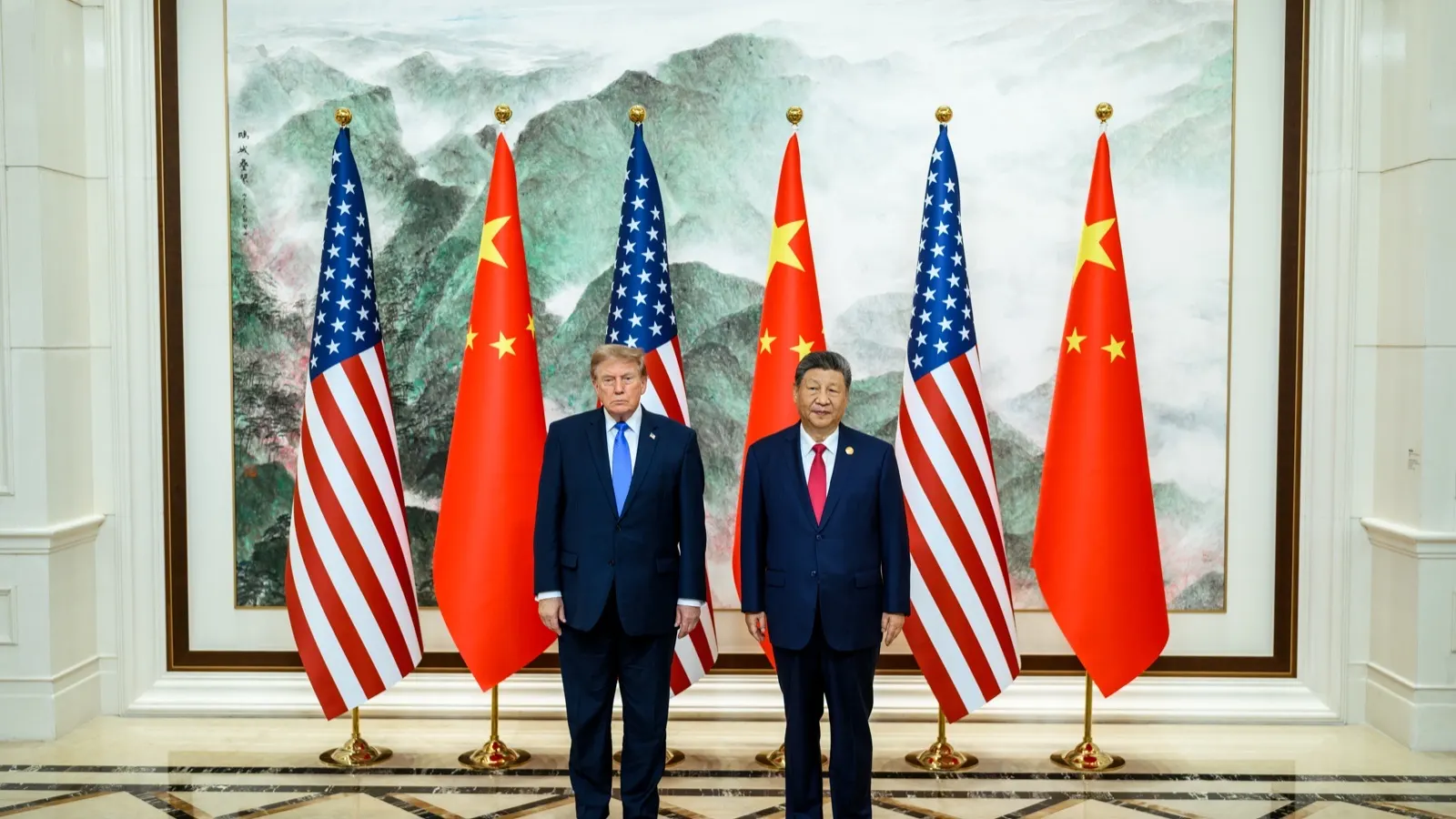
President Donald Trump said the United States was ahead of China and the rest of the world in advanced artificial intelligence during a Nov. 19 Fox News interview from Shenzhen. “We’re leading China, we’re leading the whole world,” Trump said in an excerpt released by the White House.
Trump said he had discussed the subject with Chinese President Xi Jinping. His account describes their conversation from his perspective. The interview excerpt offered no benchmark, time period or definition of a lead. The clearest public evidence supports a sizable U.S. advantage in private investment and a much smaller gap on one dated measure of leading models.
The U.S. leads by a wide margin in private investment
The 2026 Stanford AI Index put U.S. private AI investment at $285.9 billion in 2025 and China’s at $12.4 billion. Dividing those published figures gives a ratio of about 23 to one. That comparison shows the scale of private financing recorded in the report. Government funding, the stock of computing equipment and the performance of the systems that money helps build are different measures.
Investments can support researchers, chips, data centers and distribution. Those inputs can help companies improve their products or put existing systems in front of more users. The investment ratio by itself cannot tell a business how well an AI system will answer a specific question, summarize a contract or write a piece of software.
There is a newer number with a different scope. In a November update, Stanford researchers said worldwide corporate AI investment had already exceeded $1 trillion in 2026. That figure covers a global total and uses a broader investment category. It measures the overall scale of the boom. The U.S.-China comparison above is for private investment in 2025.
The model performance comparison is much closer
Stanford’s technical performance chapter found that leading U.S. and Chinese models traded places at the top of its performance comparison more than once from early 2025. The chapter put the top U.S. model ahead by 2.7% in its March 2026 snapshot. That is a gap on the report’s comparison, at the date measured. The chapter does not tell readers where every newer model in November would place.
A model ranking can change as companies release new versions and evaluators change the tasks, settings or sample of systems. The relevant comparison depends on whether a reader cares about writing, reasoning, software, cost or the ability to deploy a model under local rules. A general ranking captures a limited slice of that picture. A business deciding which model to use can learn more by testing current versions against its own work.
What counting model releases can tell us
The Index offers a third measure of competition. Using data from Epoch AI, it counted 50 notable models from the United States and 30 from China in 2025. That is a gap of 20 models, or about 1.7 U.S. releases for every Chinese release in the tracked group. The count covers the models selected for the dataset. An institution that releases several notable models adds several entries, regardless of how those models perform on any one benchmark.
Put the figures alongside one another. The 2025 private investment ratio was about 23 to one. The notable-release ratio for the same year was about 1.7 to one. Stanford’s reported March 2026 performance gap was 2.7% at the top of its comparison. The ratios and the performance figure use different inputs and answer separate questions, but the differences in scale help show why one statement about an AI lead can be interpreted in several ways.
How to assess the next claim about who is ahead
Start with the date. A result from March can help establish a baseline. A statement in November about the latest systems calls for newer scores that identify the exact models and test settings. Then check the task. The Stanford chapter discusses both human-preference rankings and specific tests for capabilities such as coding. A high ranking for how people prefer answers can coexist with weaker results on a narrowly defined task.
For decisions about adoption, the next questions are what a model costs to run, how often it fails on the work that matters, and whether it can be used under the organization’s data rules. An engineer evaluating code generation, for example, may care about whether the result passes tests and how much staff time it takes to review. An investor tracking national capacity may care more about the flow of capital and the number of teams releasing systems. Those are different demands on the evidence.
The November investment update illustrates another point. A newer date helps only if the number measures the same thing. Stanford’s latest global corporate total cannot be divided by the earlier Chinese private-investment figure to produce a meaningful bilateral ratio. A new comparison would need country data for the same period, from the same investment category.
What Trump meant by “super intelligence”
The White House grouped the remarks under “Super Intelligence.” A footnote in the separate Nov. 17 Quad statement says Australia, India and Japan use the term there to refer to artificial intelligence. Readers should distinguish that diplomatic label from a claim that a system has crossed a defined threshold for capabilities beyond humans. Trump offered no test of such a threshold in the White House excerpt.
The takeaway from the two sets of numbers is specific. The United States drew much more recorded private AI investment in 2025. Leading models were considerably closer in Stanford’s March comparison, and a November ranking would need November evidence. The size and date of each measure matter more than a broad verdict about who is ahead.
The AI comments were one part of the Shenzhen interview. Newsmerica also examined what Trump said about U.S. technology outages and covered the three-way meeting with Xi and Vladimir Putin.
Trust & transparency
How we handled this story
The White House excerpt confirms the quote. Stanford’s 2026 AI Index provides the private investment data, count of notable 2025 releases, and dated March 2026 performance snapshot. Its November release measures global corporate investment.

Grounded in this reporting
Ask Newsmerica
Ask about this article. Answers quote the closest published passages and link back to their sources.
This tool retrieves article passages; it does not add outside facts.Keep exploring