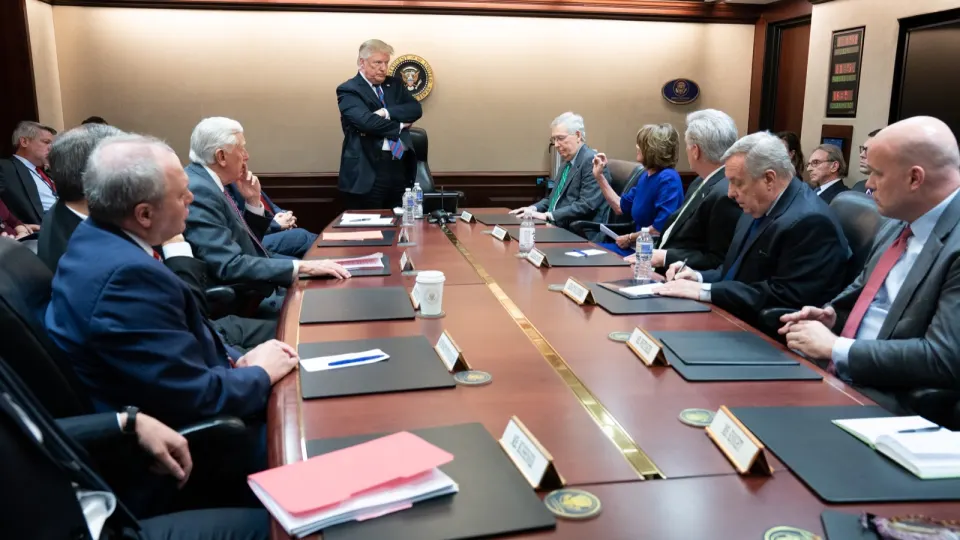
Trump orders federal contractors to notify White House about congressional inquiries
Trump’s order adds a White House notification step for certain congressional inquiries. See how privilege, enforcement and employee disclosures fit.
President Donald Trump has directed federal contractors to notify the White House and the agencies that hired them when Congress requests information about their work or communications with the executive branch. The Nov. 20 executive order also instructs contractors to follow directions to withhold communications that the White House or an agency determines are protected by executive privilege.
The move affects companies and their subcontractors as well as the agencies that oversee their work. It adds an executive-branch coordination step at a point when lawmakers may be trying to obtain records from companies directly. The order leaves agencies and the Office of Management and Budget to work out how compliance will be administered.
What happens when Congress requests records
First, the company tells the executive branch. Section 2 covers pending and future congressional requests that concern the contractor’s communications or work with the executive branch. The contractor is directed to notify both the White House and the contracting agency. The scope of the request matters. The text describes inquiries tied to executive-branch work or communications, with a separate provision covering subcontractors working on federal contracts.
Second, the agency helps coordinate a response. The order tells agencies to work with contractors and the White House on responses, including decisions about asserting privilege. It directs contractors to obey withholding instructions concerning communications that the White House or the agency determines are privileged. The White House fact sheet frames the order as a way to protect confidential communications and sensitive government work.
Third, agencies consider enforcement. The order tells agencies to consider responses consistent with applicable law if a contractor or subcontractor fails to comply. Potential responses include contract termination, cancellation, suspension or debarment. They are possible enforcement actions. The order provides for OMB guidance on monitoring compliance and coordinating responses, and it directs agencies to inform contractors and subcontractors of their obligations.
Why the type of congressional request matters
Congressional inquiries can take several forms. A letter asking a company to save emails or messages preserves records for future review. A request to give a committee copies seeks production of those records. A subpoena adds a formal demand with its own procedures. The difference matters when identifying what a committee has asked a recipient to do and when deciding whether the recipient has actually provided anything. The Congressional Research Service oversight manual describes those oversight tools and the disputes that can arise over executive privilege.
The House Oversight Democrats’ Nov. 19 release said Rep. Robert Garcia sent preservation letters to people and companies tied to several planned inquiries. The Associated Press reported that the contractor order followed other efforts by the administration to coordinate responses to congressional oversight. Newsmerica’s account of the preservation letters explains what those earlier requests sought.
Where employee whistleblower protections fit
A company responding to a committee and an employee raising concerns about misconduct can face different legal questions. Federal law under 41 U.S.C. § 4712 protects covered contractor and subcontractor employees from certain reprisals for disclosing information they reasonably believe shows specified misconduct. That can include gross waste of federal funds, gross contract mismanagement, or a substantial and specific threat to health or safety.
The statute lists a member of Congress or a committee representative among the recipients who can receive a covered disclosure. Inspectors general and other bodies are also listed. The details of the disclosure and the applicable law matter in individual cases. The order itself says its implementation must be consistent with applicable law. The relationship between the two could become clearer once agencies explain how they plan to apply the order.
Which records will show how the order is applied
The most useful next records are the published order, OMB guidance, an agency’s instructions to contractors, and any public dispute over a specific request or enforcement decision. Together those would show whether committees, agencies, and companies are using the process as described in the Nov. 20 text.
There is also a discrepancy between the official sites. The White House page labels the contractor order 14438, a number the published Federal Register assigns to an Oct. 22 housing order. The title and signing date identify the contractor order while the publication record is checked.
Trust & transparency
How we handled this story
Read the original order and fact sheet, checked the whistleblower text and the Federal Register record, and corroborated the order with AP. The order is identified by title and date pending publication reconciliation.

Grounded in this reporting
Ask Newsmerica
Ask about this article. Answers quote the closest published passages and link back to their sources.
This tool retrieves article passages; it does not add outside facts.Keep exploring