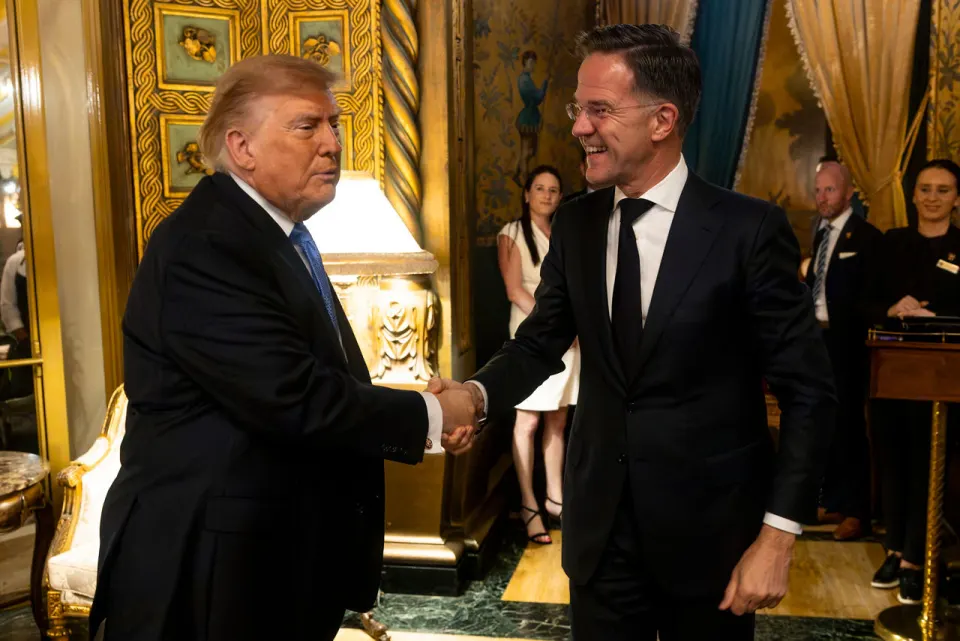
Trump cites China competition in defending crypto at his meme-coin dinner
Trump cast his crypto support as a response to competition from China. The dinner’s token rules and federal stablecoin law cover different activities.

President Donald Trump told guests at his meme-coin dinner Sunday that he supported cryptocurrency to help the United States compete with China, Reuters reported. He spoke at Trump National Golf Club in Sterling, Virginia, where the organizers had offered dinner invitations based on holdings of the $TRUMP token.
“If we don’t do it, China’s going to do it,” Trump told attendees, according to Reuters. The account supplies the president’s rationale from inside the private event. The organizers’ event page independently identifies Trump as the featured speaker and spells out how eligibility worked. Newsmerica’s earlier report explained the contest rules ahead of the dinner.
What the dinner measured
The organizers advertised places for up to 185 holders and used a formula that considered how many tokens a participant held and for how long. Reuters reported that the public leaderboard listed 130 wallets at the cutoff. That was 55 fewer than the advertised number of places, a gap of about 30%. The comparison describes the published list and the event’s advertised capacity. Actual attendance is a separate figure, and one wallet does not necessarily represent one person.
The organizers used different criteria for different perks. The event page set a Nov. 16 cutoff for VIP bonus eligibility and offered the top four holders a gold watch if they met a minimum token-holding threshold. Those terms help explain why a single number cannot answer how many wallets qualified for a perk, how many people registered or how many guests walked in on Sunday.
Which crypto policy applies to what
Trump’s remarks addressed a broad industry, while the dinner’s entry rules applied to one token. Fight Fight Fight LLC, the company behind the site, says in its Coin Club terms that $TRUMP is intended as an expression of support. The terms say the token lacks payment functionality and cannot be redeemed for cash, goods or services.
The eligibility rules linked holdings to an invitation through a separate contest. That matters when reading the terms: the organizer could consider holdings when choosing invitees without giving each token holder a standing right to a benefit. The site says that holding the token does not guarantee any reward or experience.
The GENIUS Act addresses a different category of digital asset: payment stablecoins. The federal statute sets requirements for permitted payment-stablecoin issuers, including reserves that back the tokens at least one to one. The law’s reserve provisions explain what a regulated payment instrument is designed to do. The Coin Club’s terms explain what holders can expect from the particular token tied to the dinner.
| Question | $TRUMP dinner token | Payment stablecoin under the GENIUS Act |
|---|---|---|
| What does the holder receive? | The club describes the token as an expression of support. Dinner invitations followed the contest rules. | The law defines a category of digital asset designed for payment or settlement with an obligation to redeem at a fixed amount of monetary value. |
| What backs the redemption promise? | The club’s terms give holders no right to redeem the token for cash, goods or services. | Permitted issuers must maintain identifiable reserves of at least one to one, using eligible assets. |
| Which records apply? | The promoter’s token terms and the rules for each experience. | The statute, the issuer’s redemption policy and the applicable implementing rules. |
For example, a permitted issuer with $100 million of outstanding payment stablecoins would need at least $100 million in eligible reserves under the statute. The comparison is between the issuer’s outstanding redemption obligations and its reserve assets. The dinner ranking measured participants’ token holdings over time to determine access to the event and particular perks.
Timing matters for the legal side as well. Section 20 sets the general effective date as the earlier of 18 months after enactment or 120 days after the primary federal regulators issue final implementing rules. The SEC staff’s guidance identifies Jan. 18, 2027, as the 18-month date. The date that governs a particular obligation depends on the statute and its implementation.
The SEC’s March 2026 interpretation also distinguishes broad categories of digital assets and the circumstances in which a transaction can be subject to securities law. It explains why an asset’s characteristics and the way it is offered both matter. The event’s attendance rules, the token’s own terms and the published regulatory texts answer separate questions. The president’s comparison with China described his policy rationale for supporting crypto.
What the dinner leaves unresolved
Democratic senators led by Elissa Slotkin and Adam Schiff asked the administration in October about the event’s ethics review and financial benefit to the president. Their letter sought a briefing and answers about the approval process. The published leaderboard shows which wallet entries appeared at a cutoff. A verified attendance record or an official answer on ethics review would address other parts of the senators’ request. Reuters reported that the White House and the token project did not respond to its requests for comment.
Trust & transparency
How we handled this story
Reuters supplies Trump’s private-event quote and the reported public leaderboard count. The event page and the Coin Club terms verify the invitation and token terms. The enacted GENIUS Act, SEC staff guidance and the SEC interpretation support the regulatory distinctions. The senators’ original letter confirms what they asked the administration to explain.

Grounded in this reporting
Ask Newsmerica
Ask about this article. Answers quote the closest published passages and link back to their sources.
This tool retrieves article passages; it does not add outside facts.Keep exploring