BepiColombo reaches Mercury orbit after eight years in space
ESA confirmed BepiColombo reached Mercury orbit. The two spacecraft are due to separate in December, with science operations planned for April 2027.
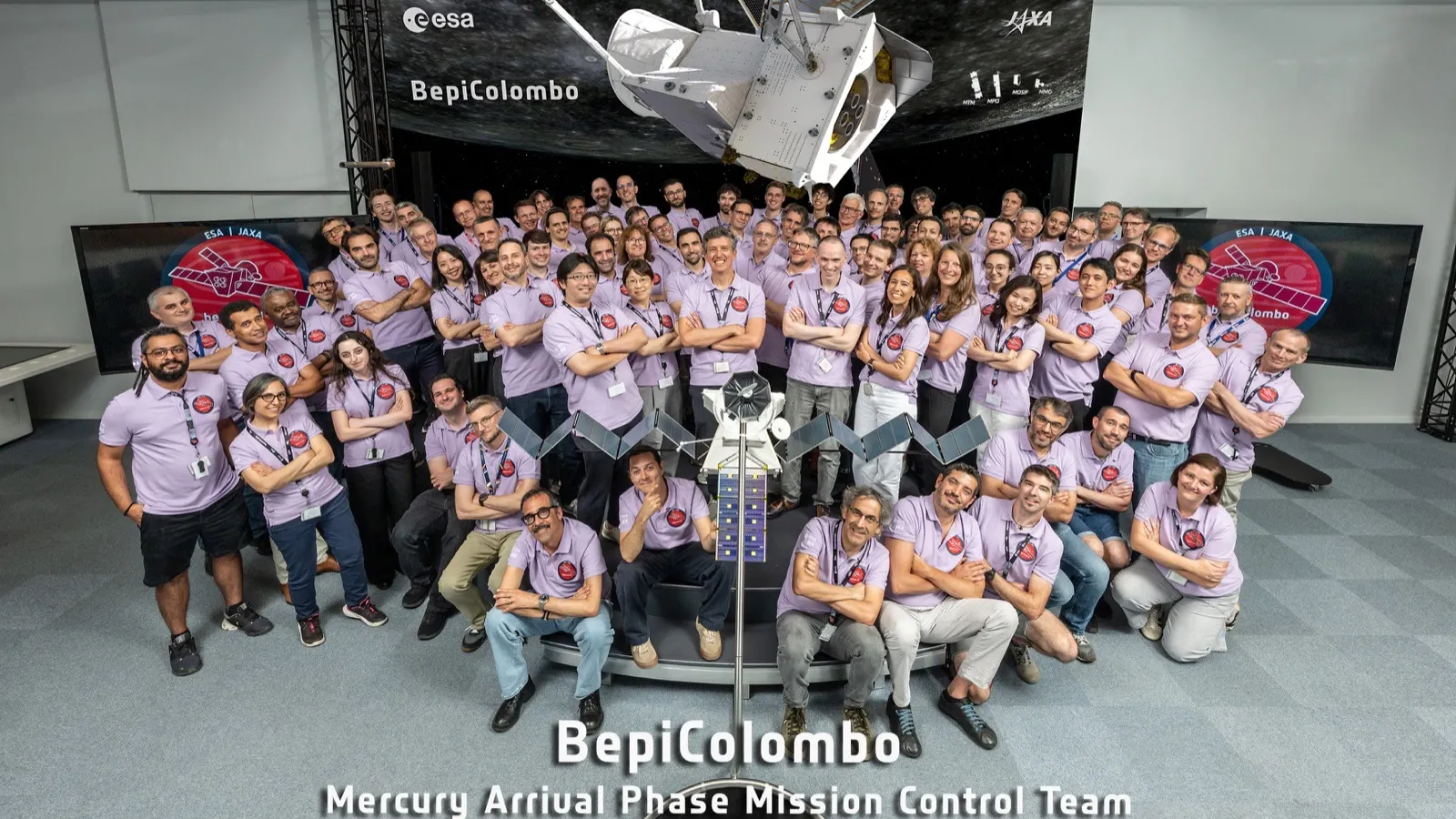
The European and Japanese BepiColombo mission has reached orbit around Mercury, ending a journey that began in October 2018. The two science spacecraft entered orbit while still joined. Their next milestone comes in December, when the European orbiter is scheduled to release its Japanese partner so they can begin working toward separate observing paths around the planet.
ESA Operations confirmed orbital capture late Saturday in the United States, after contact was restored and the flight dynamics team had determined the spacecraft was bound to Mercury. Controllers in Germany were still assessing telemetry when ESA posted that update. The Associated Press independently reported the arrival. The confirmation completes the capture stage, and the mission has several more steps before routine science operations.
Three milestones from arrival to science
The mission began dismantling its cruise configuration in September. ESA said it released the Mercury Transfer Module on Sept. 3 after that module had provided propulsion for much of the trip. The European spacecraft, the Mercury Planetary Orbiter, took over steering while JAXA’s Mercury Magnetospheric Orbiter, also called Mio, remained attached. The two entered orbit together on Nov. 21. The ESA arrival log follows the preparations and the earlier separation.
Next, ESA’s arrival timeline gives Dec. 9–10 as the planned window to release Mio into its own elliptical polar orbit. The European spacecraft is scheduled to shed Mio’s sunshield afterward and descend toward a separate orbit. Engineers must commission the spacecraft and instruments before the science phase, which ESA schedules for April 2027. ESA notes that mission operations can shift exact dates.
There are therefore three milestones a reader can follow. Capture means the joined spacecraft is in orbit. Separation gives the two spacecraft independent paths. Science operations begin after the teams have checked the orbiters and their instruments. Each step has its own confirmation and each answers a different question about the mission’s progress.
Reaching the planet took nine flybys along the way, one at Earth, two at Venus and six at Mercury. JAXA describes them as a way to change the spacecraft’s motion relative to the planets while saving propellant. The mission could use close passes to adjust its path well before the November capture. Scientists will now use that orbit to complete a different series of maneuvers and separate the two spacecraft.
Why Mercury gets two orbiters
The European orbiter is designed to study the planet itself, including its surface and the composition of the material around it. Japan’s Mio will concentrate on Mercury’s magnetic environment and the way it responds to the solar wind, according to JAXA’s mission overview. Mercury’s proximity to the Sun makes conditions around it useful for observing how that stream of charged particles interacts with a planet’s magnetic field.
The value of the pair is that the spacecraft can sample different locations around Mercury during the same period. When conditions change quickly, two vantage points can help researchers test whether they are seeing a change over time or a difference across locations. Mio’s elongated orbit and the European spacecraft’s closer observing path give each a different view of the same planetary system. NASA’s mission account describes the two-spacecraft design and the instruments aboard.
The NASA instrument on board
The United States has a role in the mission through Strofio, a NASA-funded instrument on the European orbiter. It will measure neutral particles in Mercury’s exosphere, a sparse layer of material above the planet. That measurement complements Mio’s look at charged particles and magnetic conditions. The teams can use measurements from both spacecraft to examine how material moves between the surface and the space around Mercury.
NASA’s MESSENGER mission provides a baseline. It entered Mercury orbit in 2011 and spent about four years mapping the planet and measuring its environment before it ran out of fuel in 2015. Its records give later researchers surface and magnetic observations to compare with BepiColombo’s measurements. The new mission adds concurrent observations from two orbiters once both are operating.
ESA’s operations team said it expected to share a further update early in the week. The next major date on the published schedule is the December separation window. After that, the first science results will depend on the instrument checks and the work of bringing the two spacecraft into their planned observing orbits. Newsmerica’s Tech & AI section follows space missions and the technology behind them.
Trust & transparency
How we handled this story
ESA Operations confirmed capture on its official Bluesky account at 00:56 UTC Nov. 22, corresponding to Nov. 21 Eastern time. ESA, JAXA, NASA and AP corroborate mission history and planned milestones. Schedule dates are labeled as operational targets.

Grounded in this reporting
Ask Newsmerica
Ask about this article. Answers quote the closest published passages and link back to their sources.
This tool retrieves article passages; it does not add outside facts.Keep exploring
More from Newsmerica
Related coverage
Technology & AI
Plex will end TheTVDB metadata support on Dec. 3

Technology & AI
Tesla begins rolling out supervised Full Self-Driving v15

Technology & AI